 Materials Library
 Articles
 E-Books & Guides
 Manufacturing Stories & Cases
 Webinars
 Guides & Tools
Rapid Prototyping Services Online
Get Your Rapid Prototyping Quote
Thanks to a wide range of available manufacturing technologies and materials, prototypes work for both functional and visual testing.




What is Rapid Prototyping?
Rapid prototyping is a product development method that uses turnkey manufacturing technologies to quickly produce multiple iterations of a component for testing and evaluation. 3D printing is most often chosen for rapid prototyping because of its affordable price point and its quick turnaround time of 3 business days. Other common rapid prototyping processes include CNC machining, sheet metal fabrication, and rapid injection moulding.
Speed and affordability are the key principles of rapid prototyping and allow multiple designs of a prototype to be manufactured at once, or one prototype to be revised and produced a few times with diverse designs and materials in a short amount of time. These prototypes provide critical information that helps engineers make design decisions before moving to higher fidelity models for functional testing and production.
Why Choose SYR for Rapid Prototyping




Rapid Prototyping Processes
SYR offers a variety of rapid manufacturing processes that can be used to create prototypes quickly and at a low cost. In recent years, advancements in additive manufacturing technology have made 3D printing a go-to choice for engineers in search of rapid prototyping solutions, as parts can be printed quickly and cheaply in a variety of different metals and plastics.
But CNC machining, sheet metal fabrication and injection moulding are also to be considered as viable options for specific purposes, such as evaluating the prototype in its final metal material or testing a part with multiple backup parts.
> 3D printing: the most common rapid process in terms of prototyping, as it is a fast and affordable technology
> CNC machining: attractive for prototyping as it allows to make modifications to the design and to test several iterations very easily and quickly with high levels of accuracy and precision. CNC machined parts can be manufactured in a wide range of metals and plastics and are shipped within 7 days.
> Sheet metal fabrication: rapid sheet metal fabrication is a good option for quick-turn flat parts that require the prototype to be evaluated in its final metal material. These parts can be manufactured in a week or less and can often be cost-effective enough to produce two or more prototype designs in parallel
> Injection moulding: rapid injection moulding process results in a durable set of identical parts for testing with multiple backup parts. It is usually used for high-fidelity product evaluations, but also as bridge tooling for temporary production at a product launch. Injection moulding has very good repeatability and net final shapes. The usual lead time for rapid tooling is 2-3 weeks for the initial parts.
Rapid 3D Printing Processes
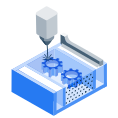
Selective laser sintering (SLS)
It is one of the most versatile methods for rapid prototyping due to functional mechanical properties, good detail resolution, and low costs

Stereolithography (SLA)
It has a very good surface finish, high detail accuracy as well as tolerances. SLA is great at prototyping clear parts

Fused deposition modeling (FDM)
It can rapidly produce large and bulky parts with a wide variety of engineered thermoplastics (ABS, PC, ULTEM)
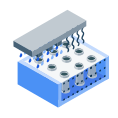
HP Multi Jet Fusion (MJF)
It is a powerful 3D printing technology that produces highly accurate and durable parts at fast speeds.
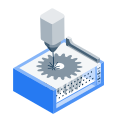
Direct Metal Laser Sintering (DMLS)
It is a metal 3D printing technology that selectively fuses a fine metal powder in aluminium or stainless steel.

Carbon DSL
It allows you to bring unique products to market by introducing previously impossible designs, consolidated parts, faster iterations, and programmable lattices.