
 Materials Library
 Articles
 E-Books & Guides
 Manufacturing Stories & Cases
 Webinars
 Guides & Tools
Vacuum Casting Services Online
- Rapid quoting within 48 hours
- Durable parts with production-level quality
- Low-cost and quick turnaround for high-quality plastic parts
Start A New Casting Quote
STEP | STP | SLDPRT | STL | IPT | 3DXML | CATPART | PTC | PRT | SAT | PDF




Vacuum Casting Process
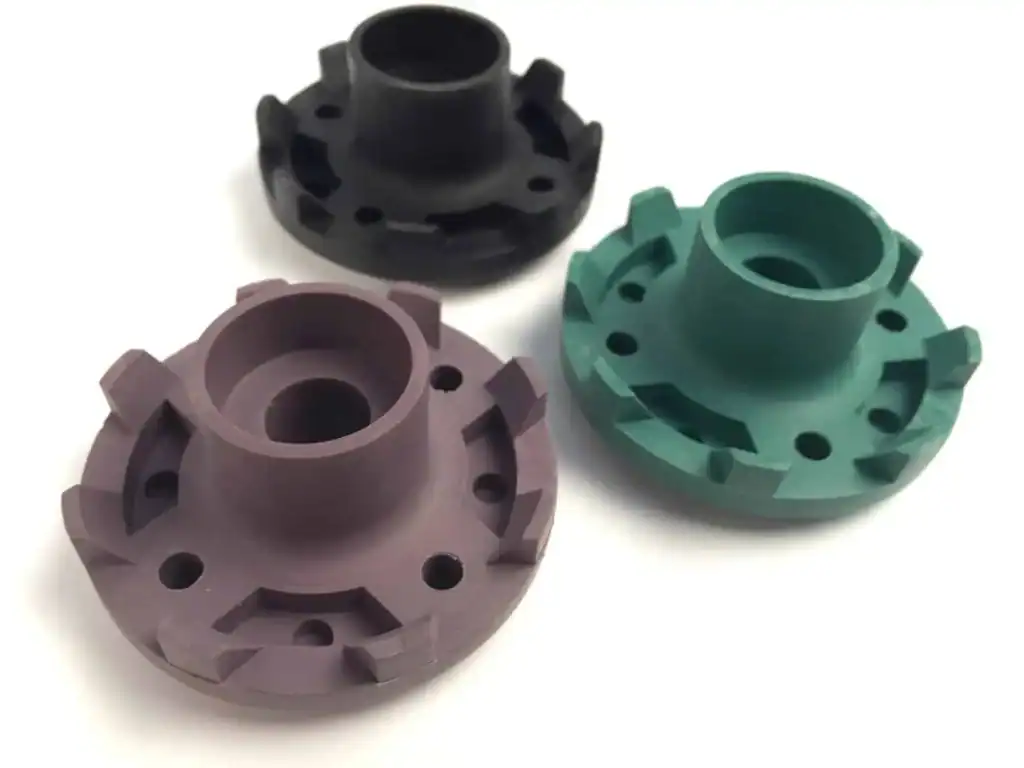
Vacuum casting is a technique for producing end-use, rigid, flexible, and rubber parts with production-level quality. This process uses a 3D printed master pattern and silicone moulds to produce high-quality, short-run parts up to 2300 mm long. The finished dimensions of urethane cast parts depend on the accuracy of the master model, part geometry, and casting material.
Vacuum cast parts are frequently used when colour, surface quality, and toughness are required. Vacuum casting is a perfect alternative for insert moulding in low volumes and is compatible with a wide range of materials. Polyurethane casting can also be used for bridge tooling between a 3D printed rapid prototype and injection moulding to effectively balance quality, cost, and time. Vacuum cast parts can also be clear, colour-matched, painted, have installed inserts, and even custom finished.
Applications of Vacuum Casting

Low-volume production

Advanced prototyping

Market testing
Vacuum Casting Materials Selection
Rigid Plastics
- PU8150, ABS-like
- PU8263, ABS-like UL94-V0
- PX223HT, ABS-like high-temperature resistance 120
- UP6160, ABS-like high-temperature resistance 200
- UP4280, ABS-like
- PX5210HT, PMMA / Acrylic-like transparent
- PX522HT, PMMA / Acrylic-like
- 8550, PP-like
- UP5690, PP-like
- PX527, PC-like
- PA 6 (DPI 2180)
Rubber-Like Plastics
Vaccum Casting Post-Processing Options

As cast
As cast
As-cast parts retain the natural surface texture and appearance that results from the casting mold.
Metallisation
Metallisation
Metallisation involves applying a thin uniform metallic coating to the surface of a cast part. This technique enhances the part’s appearance and provides a reflective, metallic finish.
Mirror polishing
Mirror polishing
Mirror polishing involves and excessive polishing of the master model to achieve a flawless, reflective surface. It ensures the highest level of surface quality, equivalent to the SPI A-1 standard in injection moulding.
Smooth
Smooth
A smooth finish is achieved by carefully polishing or grinding the surface of a master model to remove visible marks and imperfections from 3D printing or CNC machining, resulting in a uniform, mark-free surface.

Spray painting
Spray painting
Provides a continuous, protective colour finish which is applied by spraying.
Custom
Custom
If you select a custom finish in the Instant Quoting Engine it will require manual review. Manual quoting usually 1-2 business days.
Why SYR Is the Right Partner for Your Vacuum Casting Projects




Vacuum Casting Tolerances
Tolerance values in vacuum casting depend on part dimensions and design complexity. The table below provides example tolerances based on various dimension ranges*:
| Dimensions (mm) | 0 — 25 | 25 — 50 | 50 — 75 | 75 — 100 | 100 — 125 | 125 — 150 |
| Tolerance (mm) | ±0.3 | ±0.35 | ±0.4 | ±0.45 | ±0.5 | ±0.55 |
*The values provided are illustrative. Tolerances should be determined individually for each vacuum casting project based on 2D drawings and CAD models of the specific part. For parts larger than 150 mm, please supply a 2D drawing and discuss tolerance requirements with your account manager.
| Description | Tolerance Notes |
| Distance Dimensions | Irregular or overly-thick geometries may cause deviances or deflection due to shrinkage |
| Surface Quality | Surface finish is externally smoothed to a satin or matte surface. Grow lines may be present on internal or difficult-to-access features. Polishing or custom finishes must be clearly defined and agreed upon at the point of order |
| Feature Definition | Sharp corners and text may appear slightly rounded |
| Size Recommendation | We can offer vacuum cast parts as large as 2,000 mm long |
Vacuum Casting Fundamentals
What is vacuum casting?
Vacuum casting is a manufacturing process that provides end-use, rigid, flexible, and rubber parts with production-level quality. The vacuum casting process uses a Polyjet or SLA 3D-printed master pattern to create a silicone mould that produces high-quality, short-run parts as an cost-effective alternative to low-volume injection moulding.
How does vacuum casting work?
Vacuum casting is similar to injection moulding in that it requires a tool with a cavity in the shape of the final part. The major difference is that vacuum casting uses a “soft” mould made of silicone whereas injection moulding uses a “hard” metal mould that has been CNC machined.
This soft mould wears out more quickly, which is the main drawback of vacuum casting. However, the process is significantly cheaper for low-volume and prototype plastic parts that require production-level quality and surface finishes.
The vacuum casting process has 3 major steps:
- The Master Pattern: Step one involves creating a master pattern of the final part using an additive manufacturing process. The most commonly used printing processes are Polyjet 3D or stereolithography (SLA) 3D due to their ability to produce parts with high resolutions and naturally smooth finishes. The master pattern is typically hand-finished to achieve optimal surface detail before the mould tool is created.
- Moulding: In step two, the 3D printed master pattern is encased in liquid silicone that cures around the pattern, with the silicone encapsulating all the features of the printed parts. When the mould cures, it is cut into distinct halves and the master pattern or 3D printed part is removed. This leaves an internal cavity exactly shaped like the part.
- Pouring: In the final step of the vacuum casting process, silicone is poured into the silicone mould, and the mould is then placed in a chamber to help remove air bubbles in the liquid material. For opaque parts, the chamber is typically pressurised. For clear parts, the chamber typically pulls a vacuum to mitigate any bubbles and increase clarity. Once cured, the silicone halves are separated and the newly formed part is removed. This process is repeated until the desired quantity is achieved.
Why would you choose vacuum casting over 3D Printing?
One of the key distinctions between vacuum casting and 3D printing is material performance and quality. Vacuum casting offers higher-performing materials that can better emulate those used in commercial products. In addition, the fit and finish are often better with vacuum cast parts. If material performance and appearance are important to you, you should seriously consider vacuum casting.
Why would you choose vacuum casting over injection moulding?